BeryX · Healthcare
Episodes left out of the DRGs are funding that never arrives.
Patient numbers, ICD-10 diagnoses, discharge dates and HL7 interfaces. Clinical data drives billing to the national health service and statutory reporting — and almost nobody checks it before it leaves. BeryX does, without seeing who the patient is.
Free account, no card. The demo opens with data from a hospital, pseudonymised.
The pain
Clinical data is right for the doctor and wrong for the system.
Clinical coding is done by people under pressure, in systems that speak different formats.
Billing sent back
Patient numbers truncated by an Excel export, patients without a national health number: billing bounces and funding is delayed.
Diagnoses that don't count
A diagnosis in free text instead of an ICD-10 code never makes it into the DRGs — care delivered that never gets paid.
Skewed indicators
Age 999 meaning «unknown», sex «U» outside the dictionary, discharge dates in local format: length of stay and the age pyramid come out wrong.
Interfaces that stop silently
The HL7 interface with the clinical system stops and the data warehouse goes three days without new episodes — with no alarm.
How BeryX fixes it
Ready-made clinical rules, privacy by default, freshness alerts.
PT healthcare rule pack
National health number format and presence, sex dictionary, plausible age, ISO dates and principal diagnosis in ICD-10 — applied in one click.
Privacy by default
Works on pseudonymised data; samples sent to the AI are limited and can be anonymised, and the workspace AI policy decides which provider may see what.
Interface freshness
BeryX learns each table's rhythm and warns you when episodes stop arriving.
Reports per persona
The engineer gets the remediation SQL; clinical and financial management get the impact, in management language.
Proof, not mockups
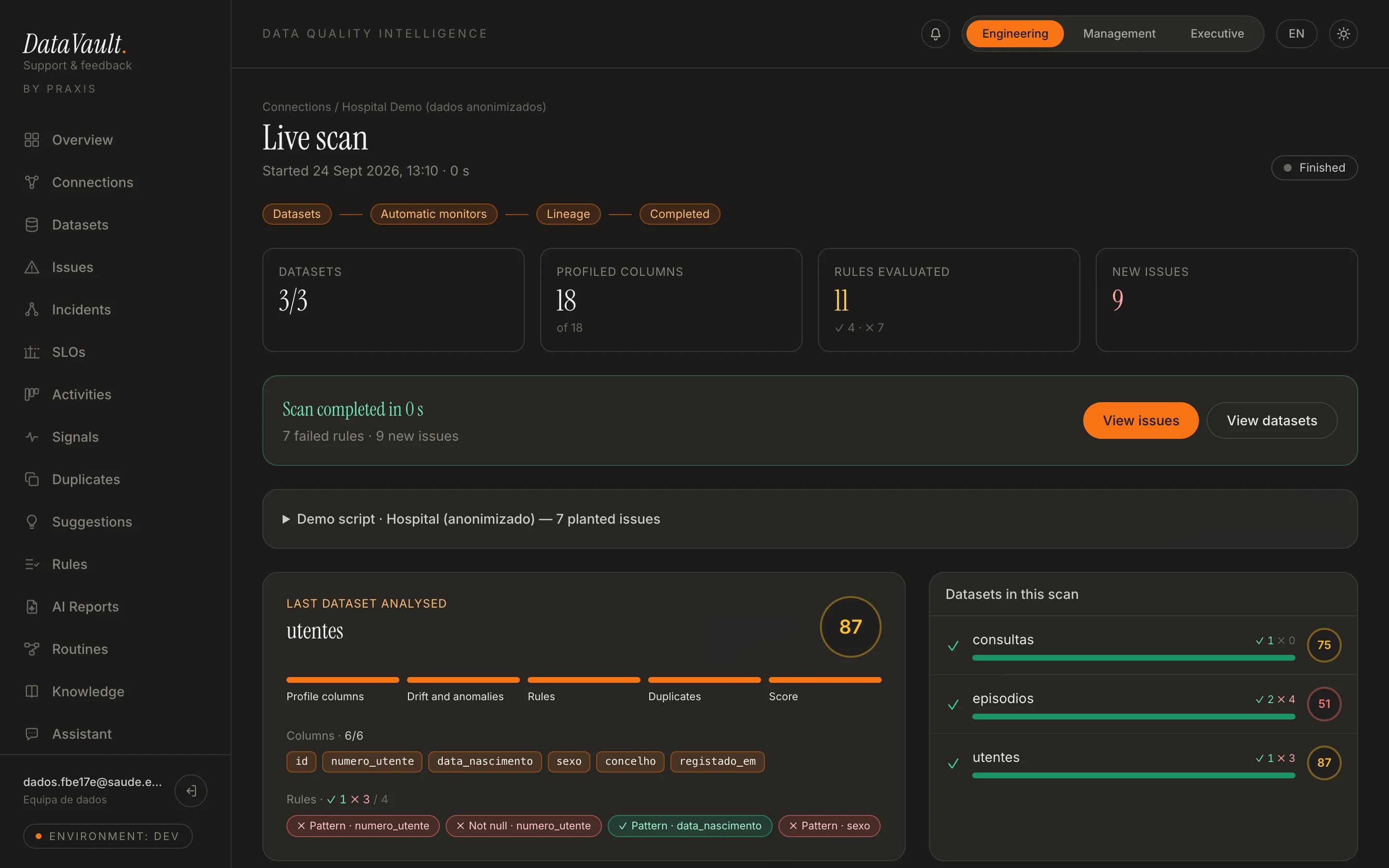
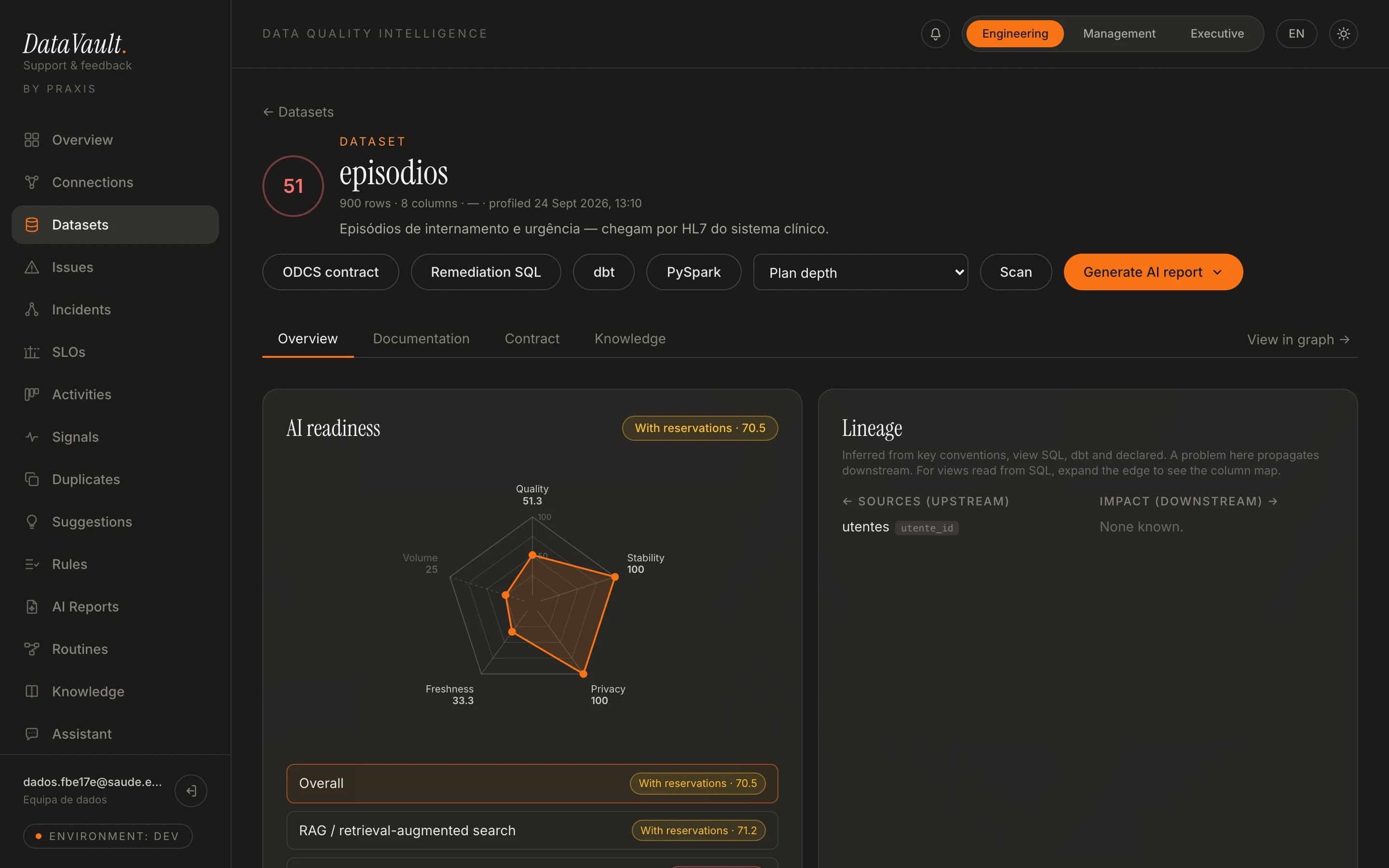
BeryX running on the «Hospital (anonymised)» demo workspace.
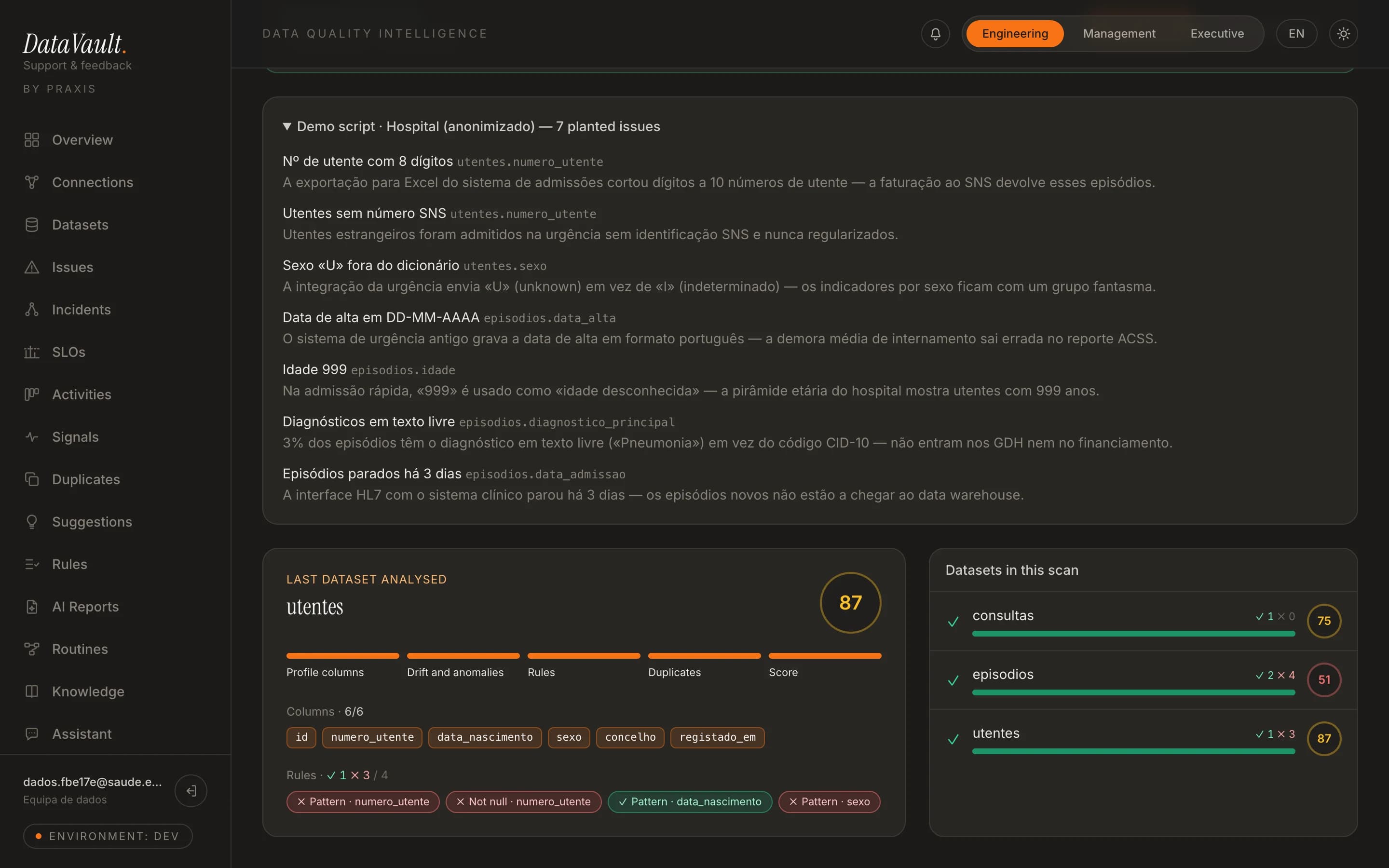
Real screenshots of the app, taken on the vertical's seed pack: fictional but plausible data, generated deterministically, with 7 planted issues — each with the backstory of the incident that caused it. The industry rule pack comes already applied, so the first scan flags exactly these issues. It's what you see when you open the demo.
What the first scan catches
7 issues, 7 stories you've seen happen.
- 01
8-digit patient numbers
utentes.numero_utenteThe admissions system's Excel export truncated 10 national health service (SNS) numbers — SNS billing sends those episodes back.
- 02
Patients without an SNS number
utentes.numero_utenteForeign patients were admitted to A&E without SNS identification and never regularised.
- 03
Sex «U» outside the dictionary
utentes.sexoThe A&E integration sends «U» (unknown) instead of «I» (indeterminate) — indicators by sex get a phantom group.
- 04
Discharge date as DD-MM-YYYY
episodios.data_altaThe old A&E system stores the discharge date in Portuguese format — average length of stay comes out wrong in the ACSS report.
- 05
Age 999
episodios.idadeIn fast-track admission, «999» means «age unknown» — the hospital's age pyramid shows 999-year-old patients.
- 06
Free-text diagnoses
episodios.diagnostico_principal3% of episodes have the diagnosis in free text («Pneumonia») instead of an ICD-10 code — they never make it into DRGs or funding.
- 07
Episodes stalled for 3 days
episodios.data_admissaoThe HL7 interface with the clinical system stopped 3 days ago — new episodes aren't reaching the data warehouse.
fictional data
Other industries
Get to the next statutory report with your data already validated.
Open the demo with a pseudonymised hospital's data and walk through the seven planted issues — or connect your own source, read-only, in minutes.